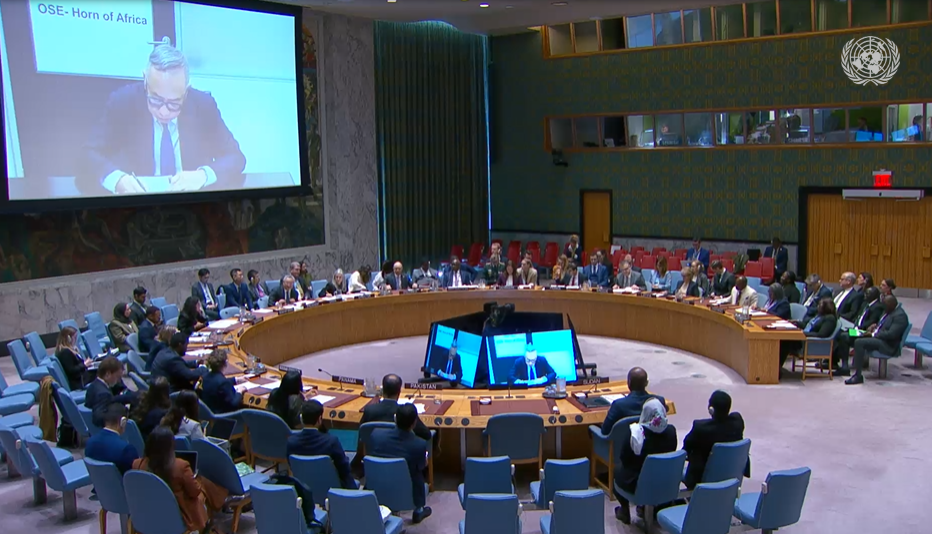
Statement by Deputy Permanent Representative Anna Evstigneeva at a UNSC Briefing on the situation in Abyei
Mr. President,
Since it is the first open meeting under the Chinese presidency this month, we would like to use this opportunity to wish our friends every success in their work in the month of May.
Mr. President,
We wish to thank Ms. Martha Pobee, Assistant Secretary-General for Africa, and Mr. Guang Cong, the Secretary-General’s Special Envoy for the Horn of Africa. We are grateful for their briefings. We welcome to today’s meeting the representatives of Sudan and South Sudan.
The process of settling the final status of Abyei, including the border demarcation between Sudan and South Sudan, is still being held hostage to the complex situation in each of these two countries. Juba continues its law-and-order operation in the northern states. The presence in the region of disruptive elements, including the Sudanese Rapid Support Forces (RSF), is also having a negative impact on the situation in Abyei. Against this backdrop, the deployment there of several hundred military personnel of the South Sudanese regular army is a necessary measure designed to prevent instability from spiraling out of control. We are convinced that as the situation improves on the external perimeter of Abyei, Juba will be able to take a decision to withdraw its forces from there.
The settlement in Abyei remains a priority for the Sudanese government. As long as there is no cessation of hostilities in the border states of Kordofan and Darfur, it is premature to talk about any dialogue regarding Abyei. We wish to stress that there are no Sudanese armed forces personnel in this disputed regions. It is the actions by the elements opposing Khartoum that are the main obstacle to launching a substantive settlement process. Furthermore, these actions pose a direct threat to UN personnel themselves. It is no coincidence that in late 2025, UNISFA was compelled to abandon the Joint Border Verification and Monitoring Mechanism (JBVMM) logistics base in the Sudanese city of Kadugli, as well as two nearby team sites. This occurred following a drone strikfe targeting the base, which claimed the lives of six peacekeepers from Bangladesh. The Council has already discussed this incident.
It is important to note that the Sudanese government is not sitting idly by. It has announced its willingness to resume meetings of the Joint Political and Security Mechanism (JPSM), as officially communicated to the Secretary-General in a letter dated April 2. Khartoum is also open to establishing a joint police force, although the modalities for their deployment require prior discussion with Juba. At the same time, we trust that the Sudanese government will positively respond to the pending issue of approving the deployment of a UN police contingent in Abyei. We believe that through dialogue, it will be possible in the future to reach mutually acceptable solutions regarding the civilian Deputy Head of the Mission. We consider that these positive steps, which Russia wholeheartedly welcomes, attest to clear progress reached in terms of implementing the benchmarks on Abyei.
We view the Interim Security Force (ISF) in Abyei as a key factor in ensuring stability in the region. The primary objective of the UN presence in the region is to enhance security, curb inter-community violence, and assist Sudan and South Sudan in their efforts to find a mutually acceptable solution to the border dispute. And UNISFA – despite the forced cuts to its staff – is coping quite successfully with all these matters. Without resolving the final status of Abyei, any talk about a drawdown or a reduction of the ISF would be premature.
Under the current circumstances, the Security Council needs to be flexible, while understanding the pressing challenges facing the Sudanese and South Sudanese and demonstrating that the UN stands ready to continue ensuring proper oversight of the situation in Abyei until the necessary conditions for dialogue between the two capitals are ripe. Pressure on the parties might have a negative impact on both the security situation and the UN’s activities there.
Thank you.