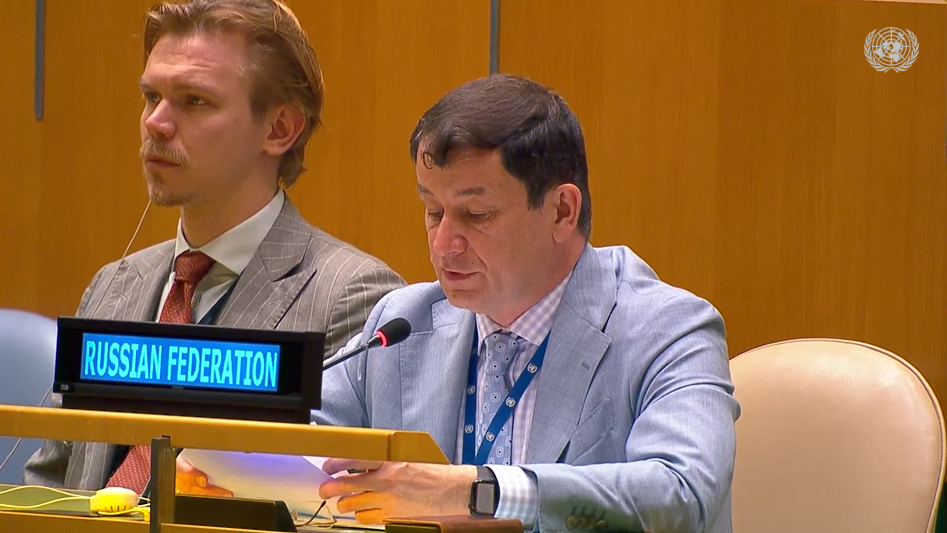
Statement by First Deputy Permanent Representative Dmitry Polyanskiy at a UNGA Meeting on Regional Zones of Peace
Mr. President,
We thank our Turkmen colleagues for organizing today's UN General Assembly meeting on regional zones of peace with the view to making a contribution to international security. As a long-standing and trusted partner of the Central Asian states, Russia supported last year's General Assembly resolution establishing a zone of peace, trust, and cooperation there. This region – which historically links East and West, South and North – is capable of playing a key role in promoting mutual respect, good-neighborliness, and rejection of the logic of confrontation.
Russia and the Central Asian states are bound by centuries-old ties of partnership, close friendship, and shared history. A vivid and symbolic confirmation of this was the participation of all Central Asian leaders in events held in Moscow this year to mark the 80th anniversary of Victory Day in the Great Patriotic War.
Russia is interested in Central Asia being a peaceful, stable, and prosperous region. We are committed to providing all possible assistance to our partners and are deepening cooperation with them on a wide range of issues. Our countries maintain close contacts at senior and top levels, we are advancing economic integration processes, and being actively engaged in a dialogue on countering drug and terrorist threats. Our country along with other CSTO member states remain the irreplaceable guarantors of security in Central Asia.
In the context of today's discussion, we express our support for other declared zones of peace in the Indian Ocean, the South Atlantic, as well as in Latin America and the Caribbean. We view the concept of zones of peace as a whole as an effective regional mechanism for strengthening security and trust, and ensuring sustainable development.
Given the erosion of universal mechanisms and attempts to substitute international law with various non-legal concepts reflecting the interests of specific groups of states, it is the development of regional formats of security and trust that becomes particularly relevant. Last year, Russia’s President Vladimir Putin proposed the concept of a Eurasian architecture of equal and indivisible security. The concept points out that the pan-European security mechanisms that were born out of the “détente” of the 1970s were effectively destroyed due to the rampant militarism of today's Europe and its complete loss of strategic sovereignty.
Therefore, we advocate a stable and equitable security system whereby all states of the continent would be involved in dialogue and none of them would strengthen their own security at the expense of others. Eurasia has enormous potential that needs to be harnessed for the benefit of all the states located there.
Such organizations as the SCO, the CSTO, the CIS, and ASEAN are meant to play a special role in this process, as aligning their efforts could help build effective formats for cooperation in the field of security. What Russia proposes is establishing a Eurasian system of bilateral and multilateral guarantees, jointly countering military threats, and ensuring lasting stability.
We invite all countries concerned to engage in an open dialogue on creating conditions for the peaceful development of Eurasia as a common space of trust and shared interests.
Thank you.