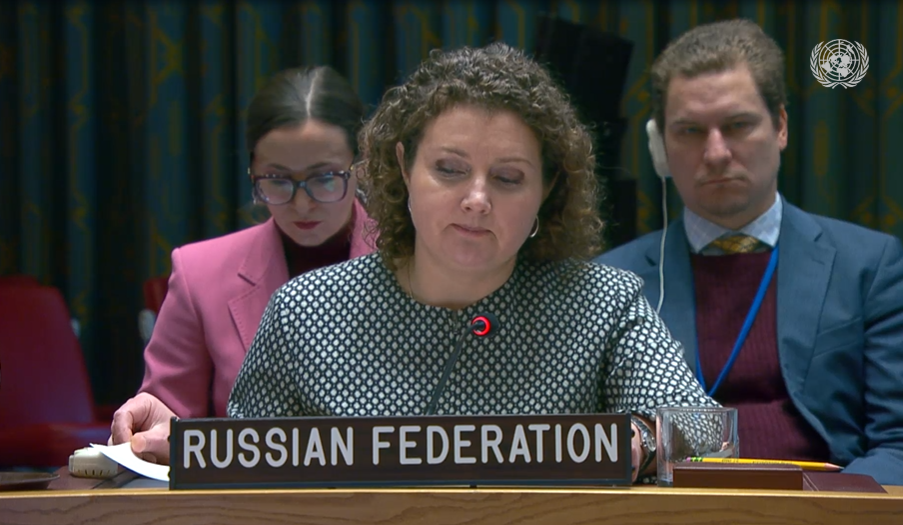
Statement by Deputy Permanent Representative Anna Evstigneeva at a UNSC Briefing on South Sudan
Mr. President,
We would like to thank Mr. Jean-Pierre Lacroix, Under-Secretary-General for Peace Operations, Mr. George Owinov, interim chairperson of the Reconstituted Joint Monitoring and Evaluation Commission (RJMEC), and Mr. Edmund Yakani, representative of civil society. We are grateful for their briefings. We welcome the participation of the Permanent Representative of South Sudan, Ms. Cecilia Adeng.
The situation in South Sudan is currently rather fraught. Clashes between government troops and opposition supporters continue unabated, engulfing more and more states across the country. Military hostilities are resulting in a higher number of human casualties, including among civilians.
We do believe that there is no military solution to this conflict. Therefore, what gains particular importance now is the action of the African community to reach a peaceful solution to the current military and political crisis in South Sudan. We highly value the mediation efforts of the African Union and IGAD, as well as that of African leaders. We note with satisfaction the outcomes of the extraordinary meeting of the Peace and Security Council (PSC) of the African Union held on January 23, which reaffirmed that there is no alternative to finding peaceful solutions on the basis of the provisions of the Revitalized Peace Agreement.
We cherish the hope that the Government of South Sudan and the opposition, acting with support of other countries of the continent, will demonstrate political wisdom and will manage to prevent further escalation of the armed confrontation, reverting to the logic of the Revitalized Peace Agreement on resolving the conflict in the country, including through creating unified armed forces as a guarantee of the advancement in the peace process. As regards the timelines here, it would be well-advised to leave this matter to the discretion of Juba, insofar as hasty steps, including political ones, are liable to unleash a new wave of internal violence. We have taken note of the December decision by the eminent South Sudanese political parties geared towards ending the transition period and holding nationwide elections in December on the basis of the country's Transitional Constitution and existing voter rolls. We assume that the Revitalized Peace Agreement, which is the sole framework for advancing the political process, remains fully in force. We believe that this decision – if definitively approved – will merely imply a recalibration of priorities, not an abandonment of the agreement itself. No one but the South Sudanese can determine how to put together stable government bodies. Yet, it is important to assist the country in eliminating the potential risks of escalation in the run-up to the elections.
We are very much concerned about the dire humanitarian situation in South Sudan, which is exacerbated by seasonal natural disasters and by the influx of hundreds of thousands of refugees from neighboring Sudan and South Sudanese returning to their homes.
The work of the United Nations Mission in South Sudan (UNMISS) is a key component of the country’s progress towards peace. We trust that, despite the current financial difficulties, the Mission will continue to facilitate the implementation of the Revitalized Peace Agreement. We strongly condemn any acts of violence targeting the Blue Helmets, humanitarians, and civilians.
We consider it crucial for the UN Secretariat and the Mission itself to engage in direct and frank dialogue with the Government of South Sudan, which is to be focused on modalities for reducing the UN presence in the country. We hope that such constructive discussions will pave the way to mutually agreeable solutions to problematic issues, including the continued use by UNMISS of its bases in Wau and Bentiu. It is important that the South Sudanese are open to cooperation with the Mission and are not interested in its withdrawal. For our part, we stand ready to facilitate such an approach by Juba.
There is a need to give up unnecessary alarmism and fomenting tensions around the reduction of the UN presence. Otherwise, there is a high risk of definitively poisoning Juba’s relationship with UNMISS.
The volatile situation in South Sudan poses a grave threat to the entire subregion and creates fertile ground for major destabilization given porous borders, which facilitate the spillover of fighters and the growth of illegal arms trafficking. We are troubled by the reported use of neighboring countries' territories to fuel the conflict in Sudan.
We consistently note how pernicious the arms embargo against South Sudan is. Representatives of the African continent, among others, have constantly called for revisiting or easing this regime, as it remains the main obstacle to establishing and equipping the country's unified army. It is clear that the existing exemptions are not sufficient when it comes to addressing the magnitude of national security concerns. We will continue to advocate the easing and complete lifting thereof.
Thank you.