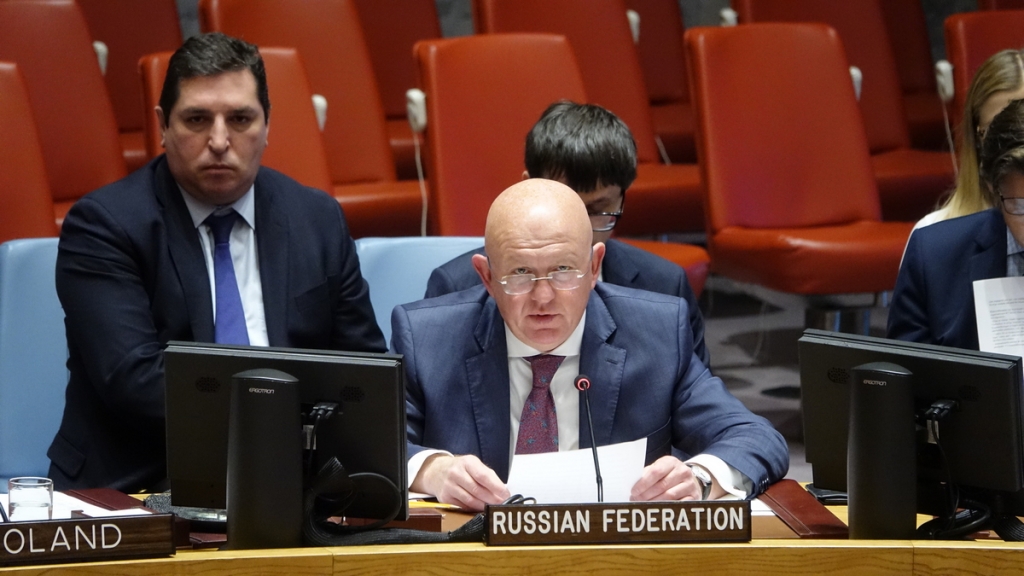
Statement by Ambassador Vassily A. Nebenzia, Permanent Representative of the Russian Federation to the United Nations, at the Security Council meeting on the situation in the Middle East
We are grateful to Mr. Mladenov and Mr. ElAd for their informative briefings.
The situation in the Middle East continues to be a complex one requiring a significant collective effort, first and foremost by the United Nations and its Security Council, which is the main guarantor of the international legal architecture. In our view, strict adherence to international law and to the spirit and letter of the Charter of the United Nations constitutes a firm foundation for developing a formula for resolving the Palestinian-Israeli conflict.
In that regard, we are seriously concerned about the aggressive re-examination of previously reached agreements, including some that have been enshrined in Security Council resolutions. We believe that any ideas and proposals in this area should be based on relevant internationally accepted principles and previously approved resolutions of the Security Council, along with the Arab Peace Initiative and the Madrid principles.
Any plans or agreements, whatever they are called, should be subordinate to the main goal of stabilizing the situation in the region by arriving at a just, long-term settlement of the Palestinian question as a key item on the Middle East agenda. We see that the Palestinian-Israeli situation is steadily deteriorating. The lack of progress in the political process has created a vacuum that is being filled with violence, unilateral measures and provocative rhetoric. We are not even supposed to mention the fact that all the long-standing problems, including settlement activity, are still a long way from being solved.
The gulf of misunderstanding and mistrust is widening, undermining the prospects for a resumption of negotiations. We cannot help feeling alarmed by the escalating tension around Gaza, the missiles launched at Israeli settlements and the answering air strikes. We condemn any displays of terror and urge all the parties to refrain from confrontational attitudes.
We appreciate the efforts undertaken in accordance with United Nations policies by Special Coordinator Mladenov and various regional players to correct the current trends and help Gazan residents. Needless to say, that assistance should be carried out in close coordination with the legitimate Palestinian authorities under President Abbas, and should be integrated into the task of restoring Palestinian unity. We note the need for sustainable funding for the United Nations Relief and Works Agency for Palestine Refugees in the Near East, whose activities for decades have had an important stabilizing effect in relieving the burden of Palestinian refugees in Gaza and countries of the Middle East.
We want to point out that the issue of refugees should be the subject of a bilateral PalestinianIsraeli dialogue, not the object of arbitrary decisions. In the current circumstances, we urgently need to mobilize efforts to revive the political process between the Palestinians and the Israelis on the international legal basis that we are all familiar with, which assumes the implementation of a two-State solution as a result of direct negotiations. Unilateral steps are not capable of achieving a just and lasting peace designed to realize Palestinians’ national aspirations and strengthen Israel’s security.
That is why we have kept our proposal for holding a summit in Russia between the leaders of Palestine and Israel on the table, with a view to enabling us to end an extraordinarily dangerous and prolonged impasse in the efforts to reach a PalestinianIsraeli settlement. Russia will continue to maintain its principled position, supporting and developing relations with all the parties in the framework of a positive agenda. We support the Middle East Quartet’s active resumption of its work of international mediators, which is still a unique mediation format approved by Security Council resolutions.
Progress in the business of resolving the acute crises in the Middle East and North Africa can be made only in a framework of broad cooperation and respect for our obligations under international law. The joint efforts of the country-guarantors of the Astana process have proved in practice that developing a common vision for a settlement in Syria is possible despite our differences. We are open to collaborating with anyone who is willing to join this process in a constructive spirit. We firmly believe that together we can do a great deal to end the bloodshed in Yemen, stabilize Libya, support normalization in Iraq and unblock other crises.
The countries of the region have a rich cultural, human and natural potential from which they can develop and even flourish, but it is a potential that will be fully realized only when interference in the region’s internal affairs comes to an end. The Russian Federation supports the formulation of a positive and unifying agenda on the Middle East, including the Palestinian question, for the Security Council and the entire international community. We believe that the Council’s meeting during our presidency on a comprehensive review of the situation in the Middle East and North Africa (see S/PV.8293) made an important contribution to the joint analysis of the genesis of the conflicts in the region and the quest for collective tools to resolve them. The key to our collective work in the region should be creating conditions conducive to strengthening a general atmosphere of trust. This is crucial to the relations between the Arab States, Israel and Iran.
We would like to remind the Council that in its resolution 598 (1987), the Security Council instructed the Secretary-General to work with the parties in the region on measures for enhancing its security and stability. This is a complicated issue, but we have to begin working on it, and we are ready to provide every possible assistance for it through our contacts with our regional partners.
The ultimate goal should be establishing a regional security architecture that is genuinely inclusive and is intended to involve every State in that part of the world. Our concept of strengthening security in the Persian Gulf under international guarantees, which we could begin to implement through a conference in which the States of the subregion participate, is still relevant, and in future could be expanded to other Middle Eastern countries.
In all these and other aspects, Russia is ready to work with interested partners on an open, impartial basis.