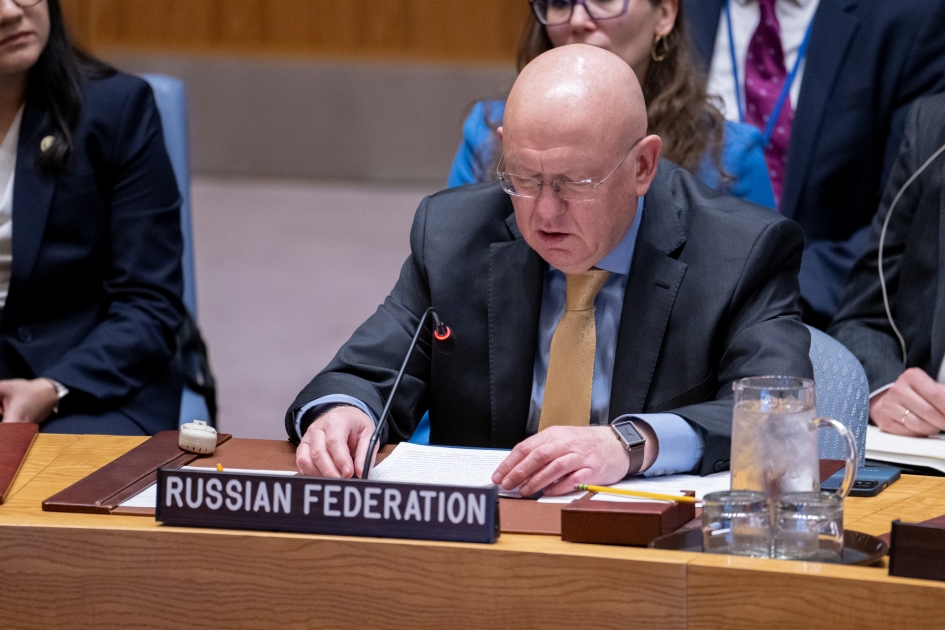
Statement by Permanent Representative Vassily Nebenzia at a UNSC Briefing on Syria
Mr. President,
We would like to thank Claudio Cordone and Tom Fletcher for their briefings on the situation in the Syrian Arab Republic (SAR).
The humanitarian needs of the Syrian population remain immense. In recent months, we have observed significant rises in prices for wheat flour, vegetable oil, and fuel, which is hitting the most vulnerable population groups particularly hard. Normalization of the situation in the area of food security is being hampered by drought and associated crop losses, by the contamination of agricultural land with explosives ordnance, as well as by the ongoing instability throughout the entire region and within Syria itself.
We are particularly concerned by the state of healthcare, water supply, and sanitation. According to WHO reports, nearly 15.8 million people need urgent medical assistance, while the system is encountering shortages of medicines, equipment, and personnel. At the same time, more than half of the country’s water supply infrastructure and about 70% of wastewater treatment facilities have been severely damaged. The recent outbreaks of hepatitis A in Daraa, Hama, and Latakia can be considered as a natural consequence of this. In this regard, we view it as extremely timely that the World Bank allocated $225 million in grants through the International Development Association in April for rebuilding water supply and healthcare facilities in Syria. These projects are expected to benefit approximately 4.5 million people. This is precisely the kind of practical investment the country needs today.
We welcome the gradual restoration of Syria’s logistics network. Ports are operational, and the airports in Damascus and Aleppo are open, although their cargo capabilities remain limited; the restoration of the railway infrastructure is under discussion. The Syrian authorities have announced the creation and expansion of a number of border crossings with Iraq, Jordan, Lebanon, and Turkey.
In this context, we take note of the termination on December 31, 2025, of UN cross-border humanitarian operations from Turkey to Syria and the transition to the use of regular, including commercial, supply channels. We believe this is the right step and a long overdue one. Aid should be provided throughout the country in coordination with the Syrian authorities, without parallel mechanisms or alternative structures, in accordance with the guiding principles enshrined in General Assembly resolution 46/182.
We also view as beneficial the current visit to Damascus by the OCHA Donor Support Group (ODSG). We trust that it will help international partners to see a real picture and to better link humanitarian response to early recovery and development efforts in line with the priorities set out by the Syrian authorities. These include healthcare, education, water supply, and energy.
Syria needs a transition from operating in emergency mode to restoring basic services, relaunching the economy, and building the basis for normal life – without politicization nor externally imposed conditions. Only such an approach will allow the country not merely to manage the crisis, but to gradually extricate itself from it.
Mr. President,
Now let us turn to the political aspects of the Syrian issue.
The US and Israel have unleashed war against Iran, inflicting devastating consequences for the entire Middle East, affecting all countries in the region to one degree or another. Syria is no exception; during the period of active hostilities, its skies were full of munitions, and Israel used its occupied territories as a staging ground to mount attacks against the sovereign territory of Lebanon under the pretext of fighting Hezbollah.
We highly commend the political foresight of the Syrian leadership; they have avoided becoming dragged into the conflicts provoked by US-Israeli aggression. In this context, we wish to highlight the further reinforcement of Lebanese-Syrian relations, which plays an important role in stabilizing the situation in this part of the region.
Unfortunately, we cannot say the same regarding the conduct of West Jerusalem, which continues to tread the path of debilitating its neighbors through direct military intervention and creation of buffer zones. This is a short-sighted policy, since, instead of strengthening its own security, Israel ends up in a hostile environment and perpetuates chaos. In the long run, achieving greater security is only possible through political and diplomatic means. We condemn Israeli occupation of the Golan Heights, and we demand the immediate withdrawal of Israeli troops from Syria. We reaffirm our staunch support for the sovereignty, territorial integrity, and independence of our brotherly SAR.
We praise Damascus’s success in bringing northeastern Syria back into a unified legal fold, and we welcome the steps undertaken by the Syrian authorities for the reintegration and upholding the rights of the people of that region. Syria’s cultural and religious diversity requires the establishment of a State where the rights of all ethnic and religious groups are equally respected in practice.
We trust that an inclusive Syrian-led and Syrian-owned political process will be pursued with the assistance of the United Nations and in accordance with the key provisions of Security Council Resolution 2254. We extend our support for the operations of the Office of the UN Secretary-General’s Special Envoy for Syria and we emphasize the importance of establishing cooperation between the United Nations and Damascus based on the host country’s national priorities.
Furthermore, we welcome the efforts of the Syrian authorities to combat terrorism and underscore our uncompromising stance vis-à-vis foreign terrorist fighters, whose ideology is incompatible with the ideals espoused by the new Syrian authorities.
Mr. President,
Russia is committed to further developing multifaceted cooperation with Syria, rooted in traditions of long-standing friendship and mutual respect. We believe that the Syrian people, who have endured a fair share of suffering, will reemerge even stronger and more resilient. For our part, we stand ready to provide every possible assistance to the Syrian authorities and Syrian people.
Thank you.