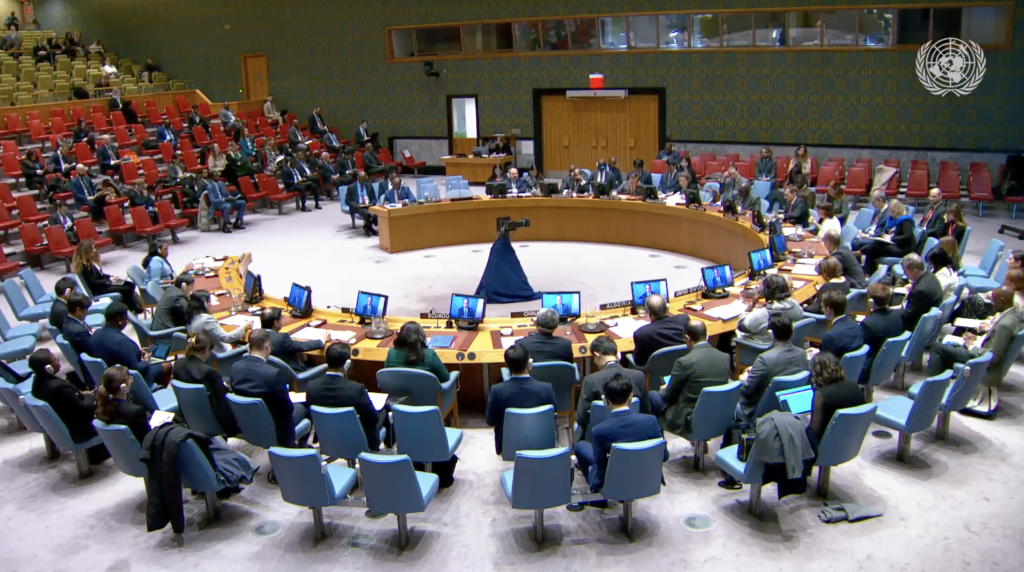
Statement by the Deputy Permanent Representative Anna Evstigneeva at a UNSC Briefing on Sudan
Mr. President,
We are grateful to Ms. Rosemary DiCarlo, Under-Secretary-General for Political Affairs and Peacebuilding, and Mr. Ramesh Rajasingham, OCHA Director of the Coordination Division, for their reports. We welcome the participation of the Permanent Representative of Sudan, Mr. Al-Harith Idriss Mohamed, in this meeting. We have closely listened to the representative of civil society.
Unfortunately, the armed conflict in Sudan has become protracted in nature, as it has been more than 18 months now since its deadliest phase began. What has been our priority both then and now is a swift cessation of hostilities. However, international efforts to settle the conflict have been faltering. The only agreement that the parties have reached so far is the Declaration signed in Jeddah. However, even this declaration remains unimplemented. At the same time, given the serious impact the conflict is having on the Sudanese people and on the socio-economic and humanitarian situation there, time and again we hear various proposals regarding a settlement; many of these proposals have little to do with reality and rather look like fake action.
We are convinced that there is no way to resolve the situation without an in-depth analysis of the root causes of the conflict, including attempts to bulldoze through so-called progressive forces that do not enjoy the support of the majority of the Sudanese people and proved incapable of addressing the main causes of the conflict at the time when they had an opportunity to do so. There is also a need for a sober assessment of how the security situation, the political landscape, the public mood in Sudan and regional approaches have changed over the past 18 months. What may have worked in May 2023 is hardly likely to work now.
Currently, as the Sudanese unity is seriously jeopardized, the Sudanese army has become the backbone of the country's statehood, and people are fleeing to areas under its control for protection. It is of fundamental importance to support the country's State institutions, which can serve as a basis for an intra-Sudanese inter-ethnic dialogue, whereby all political, ethno-religious groups and well-respected regional leaders without exception can decide together on the national development vectors. At the same time, all participants in the dialogue should enjoy support of all Sudanese people and speak on their behalf and in their interests, rather than please external patrons. The dialogue should result in sketching out the outlines of future authorities in the country, agreeable to all stakeholder, including addressing the key issue of the unification of the Sudanese armed forces.
The Russian Federation regards the Sovereignty Council as the highest legitimate authority in Sudan. We support the preservation of the country’s unity, territorial integrity and sovereignty.
In this regard, we support the efforts of the UNSG’s Personal Envoy for Sudan Mr. Ramtane Lamamra aimed at a swift achievement of peace and stability. We believe that the Personal Envoy's goal is to pull together various regional and international mediation efforts on Sudan. We wish him every success in implementing his plans to launch mediated negotiations with the Sudanese parties. However, we do not deem it appropriate to push forward any third-party negotiating formats to address the situation in Sudan if they ignore the participation of the current Government of the country and do not take into account its views on finding solutions to the crisis.
We are convinced that a key to ensuring due protection of civilians in Sudan is lifting the siege of cities by the Rapid Support Forces (RSF) and achieving a lasting ceasefire. Any steps that would pre-empt that condition – specifically if they are not agreed upon with the Government – will not bring practical results. In particular, we also find it inappropriate at this point of time to talk about any presence of the United Nations or that of African peacekeepers. As is rightly noted in the UNSG’s report on the protection of civilians in Sudan, the conditions for that are still unripe. At this stage, we view such calls as blatant populism, since no one can answer the question as to where exactly in the country such forces would be deployed and what purposes they might have. Moreover, the request for such a presence should solely come from the current Sudanese leadership. Otherwise, any peacekeeping endeavors during the active phase of this domestic conflict (quite large in geography) could spell disaster. If materialized, such a scenario could once and for all undermine Sudan's trust in the UN, and the UN’s reputation has already been seriously marred by the inconsistent activities of the UN Integrated Transition Assistance Mission in the Sudan (UNITAMS), which is already phased out.
At the same time, as we mentioned earlier, Jeddah Declaration is the only existing agreement at the moment. We therefore believe it important to step up work to enact these agreements, which cover humanitarian issues, the protection of civilians and the search for political solutions to the protracted crisis. It is important to ensure that all its provisions be upheld, including the withdrawal of armed units from towns and villages.
Mr. President,
The humanitarian situation in Sudan remains very dire. Nearly three quarters of health care facilities are not operating, there is a shortage of medicines and two thirds of the population has no access to health care. There has been documented a spread of deadly diseases. The under-implementation of the country's humanitarian response plan, which is less than two thirds funded, remains a serious challenge. We would like to assure the Sudanese that we will support them in overcoming the hardships they are going through. We are providing assistance within our means. We know that many other countries, despite the difficulties, are finding ways to provide assistance as well.
The Sudanese Government is also taking the necessary steps to ensure that aid reaches the population. There have been taken decisions to open up a number of land, air and maritime crossing points to supply humanitarian aid throughout the country, including the Adré border crossing on the border with Chad. We are confident that the continued unabated operation of that crossing point is quite possible if representatives of humanitarian structures working in Sudan, primarily OCHA, are able to implement the measures proposed by Port Sudan, which includes having the authorities present on the ground and the availability of special equipment. We consider inappropriate any excuses by humanitarian workers saying that such plans are not feasible due to the supposed unwillingness of the country’s leadership to cooperate. The examples of a number of countries in the Arab-Muslim world prove that if there is a will and if humanitarian assistance is depoliticized, aid can be supplied properly, including to hard-to-reach areas of Sudan. These claims look all the more odd given that the main problems in the delivery of humanitarian aid are caused by the RSF. It is crucial that humanitarian agencies work in conjunction with the Sudanese Government and not vice versa. At the same time, the final decision on the use of a particular border crossing for the delivery of aid is a sovereign matter for the Sudanese government to decide.
We also believe that it is premature to speak of the threat of imminent famine in Sudan. There is food in the country, for example, there has been a record harvest of sorghum. The question is how to deliver it to the people in need in the areas under the RSF’s control. It is important for humanitarian workers to give objective assessments, and check their conclusions with the Sudanese Government.
Mr. President,
We believe that the Security Council's response to the situation in Sudan should be calibrated and premised on the actual realities in the country. Any destructive external interference in the affairs of Sudan that is a friend of ours, including political interference, is inadmissible. We trust that the United Nations will be guided by these principles and will support sovereign decisions rather than imposing recipes proposed by external actors. Russia stands in firm support of efforts aimed at a lasting settlement. We are convinced that the Sudanese people can and must resolve their domestic problems on their own.
Thank you.